In BtB and BtC communication
Preferred terms:
- Hearing care professional: This term covers all people fitting hearing aids (audiologists, fitter, dispenser).
- HCP: Acronym for hearing care professional.
- Customer: Synonym for hearing care professional.
Acceptable terms:
- Audiologist: A title for a person with this profession.
Terms not to use:
- Fitter, dispenser: Do not use. Instead use hearing care professional.
- Hearing healthcare professional: Do not use. Instead use hearing care professional.
In BtB communication
Preferred terms:
- Client: e.g. clients’ needs.
- Hearing aid wearer: A person already being fitted with a hearing aid.
Acceptable terms:
- Patient: This term is reserved for medical use. Only in tools for ENTs, GPs or for CI recipients. Do not use for hearing aid wearer.
- User: Used for digital applications.
Terms not to use:
- Consumer: Do not use in BtB communication.
- End user: Do not use. Exceptions only for internal communication.
- End consumer: Do not use.
- Hearing impaired: Do not use, instead use a person with hearing loss.
In BtC communication
Preferred terms:
- You: Addressing the reader.
- User: When speaking of the consumer in the third person.
Acceptable terms:
- Consumer: When speaking in the third person, e.g. for media releases or in PR.
Terms not to use:
- End consumer: Do not use.
- Patient: Do not use, people wearing a hearing aid are not sick.
- End user: Do not use.
- Hearing impaired: Do not use, instead use a person with hearing loss.
Capitalization of titles
General default approach
For English language, we use Sentence Case as a default. Capitalize only the very first word of the title/heading and any proper nouns.
Core rules:
- Capitalize the first letter of the first word in a sentence, title, or heading.
- Proper nouns: Capitalize names of specific people, places, brands, or days (like New York, iPhone, YouTube, McDonald’s or Monday).
- Other words: Keep all other common nouns, verbs, adjectives, and prepositions in lowercase.
- Colons: Capitalize the first word that comes immediately after a colon if it starts a new rule or proper noun, depending on style.
- Acronyms: Most acronyms and initialisms use all capital letters (NASA, DNA, DNN, etc.). Shortened titles use an initial capital if they precede a name (Dr., Mr., Gov. Smith), and lowercase when standalone. When writing out full terms for capitalized acronyms, do not capitalize the words unless they are proper nouns.
If a local or national style guide for capitalization exists and is official for your context, apply that local rule for titles in that context. If there’s a direct conflict, prefer the local rule only when it’s mandated; otherwise follow Title Case Style.
Use capital letters for Phonak specific product names, programs, segments, styles, accessories, colors, marketing tools, job titles, applications or features.
• Phonak Infinio, Phonak Sky, Phonak CROS
• DirectTouch, QuickSync, StereoZoom
• Lead Generation Program, AdvantageYou
• Sales Manager, Director Science and Technology
• Premium, Advanced, Standard, Essential, Basic
• Smokey Dome, SlimTube
• Sand Beige, Brown, Lava Red Transparent, Blue Moon
• User Guide, Seminar Package, Fast Facts
Never use ALL CAPS
not in print nor in online. Exception: acronyms (e. g. CROS, DNN, AI, etc.)
Capital letters should also be used for:
• For days and months: Monday, Tuesday, January, February
• Figure, Table, Picture and their abbreviations, when used in text
• After an appendix (*), e.g. * Not available in all countries
Please note: In case you are looking for Phonak specific expressions, you might find it in the Phonak glossary.
Write out the full product name on Packaging, Frontpages, technical Documentation like Datasheets or Overviews, but also in titles and headlines.
In copy text you may write the short form of the product name omitting the ‘Phonak’.
Emphasis
Italics
- For foreign words (déja-vu, prêt-à-porter, in-situ), unless they are so familiar that they have become anglicized.
- For periodicals; this article is from Hearing Review.
Boldface
- For emphasizing words or text parts.
- To highlight [interactive surfaces] and <keyboard combinations>, often used in instructions for software or devices with a user interface.
Avoid underlines and all capitals
- Please do not use underlines.
- Please do not use ALL CAPS (exception: specific terms, e.g. Audéo YES, HI-PRO).
Dashes
There are two types of dash. The n-dash and the m-dash (the n-dash has the length of an ‘n’). With the n-dash you can indicate a range of value:
- A–Z
- 5–10%
- Monday–Friday
- 1990–2005
Hyphen –
n-dash –
n-dash short-cut on PC: <ALT> + <0150>
Hyphen
The hyphen is often used to link two or more words together.
- High-frequency sounds
- User-friendly software
- Country-specific recommendations
Also, hyphens are used in many languages for line breaks.
At Phonak, we avoid line breaks, unless for long compound words. For example, multi-microphone technology. No spacing on either side of the hyphen.
Slashes
The slash is commonly used as the word substitute for ‘or’, which indicates a choice:
- Male/female
- On/off
- Y/N
- He/she
There are usually no spaces either before or after a slash.
Exception: menu in user interface or when either of the separated items is a compound that itself includes a space. Example: Structure / Navigation of Phonak Target.
Bullets
- Each bullet with uppercase letter
- No full stop if incomplete sentences without verb
or
- If you have complete sentences, put a full stop at the end of each sentence.
- Avoid mixing complete and incomplete sentences in the same list.
- Use the same tense throughout the bullet list.
Quotation marks (“ ”)
Quotation marks should only be for direct quotes of speech. Do not use quotation marks for emphasis. Use single quotes if a word does name itself.
“English”
„Deutsch”
« Français »
- Nine years
- Two sides
- CHF 9.–
- 12 months
- 1 meter
- 2 dB
- 300 employees
Indicate thousands with a comma:
- 1,100 units
- 98,765,321 pieces
Use periods as decimal points (not commas – a common mistake when writing in English):
- 1.2 kg
- CHF 1.2 billion do not write 1,200 million
- 28.5%
Use a single space between numbers and units:
- 60 dB SPL
- 125 Hz
- CHF 1.50
Exceptions
when no spacing allows better legibility:
- Percentage: 50%, -12%
- Length in feet: 12’
- Length in inches: 4”
- Temperature in Fahrenheit or Celsius:
86°F, -10°C
Roger is a new wireless technology standard.*
Roger is a new wireless technology standard**.
If more than one footnote1 is being used on the same page2, preferably use numerals as footnotes.
* The footnote relates to the entire sentence
** The footnote relates to the word ‘standard’
1, 2 Multiple footnotes in the same publication
Citing and referencing
Phonak follows APA style on citations and references.
Note: We will adpot the current APA-Update as of March 2023 for all our tools.
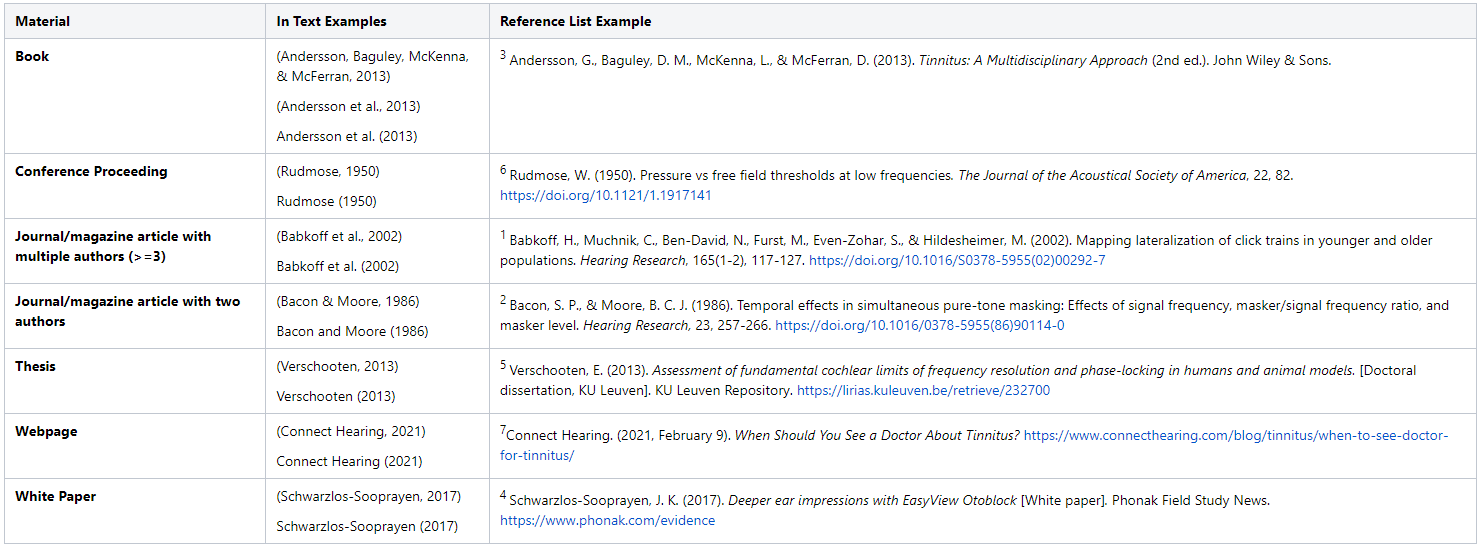
You can find more examples on APA’s official web page:
https://apastyle.apa.org/style-grammar-guidelines/references/examples
Instead of writing author and year in your text, you can also write a number in squared brackets, e.g. [1]. Please also add numbers to the reference list.
Glossary
The Phonak Glossary is the official list of currently used terms at Phonak, ensuring consistency in all of our multilingual communications and media. If you need to change or add a term, please contact: Branding@phonak.com
The boiler plate is the official profile of Phonak and should always be used when we explain who Phonak is.
It is available in 16 languages:
https://brand.sonova.com/phonak/wp-content/uploads/sites/28/2025/07/PH_Template_Boilerplate_Languages_2025.zip